This news item expired on Monday, October 30, 2023 so the information below could be outdated or incorrect.
North Carolina Oral Rabies Vaccination Program Underway for October 2023
The Wildlife Services (WS) program of the U.S. Department of Agriculture’s Animal and Plant Health Inspection Service (APHIS) is working with the North Carolina Department of Health to protect people and pets from the threat of rabies in Western North Carolina. Wildlife Services is distributing an oral rabies vaccination (ORV) bait to vaccinate raccoons, foxes, and coyotes and help stop further spread of rabies. Beginning October 3, 2023, Raboral V-RG coated sachets and fishmeal polymers will be aerially and hand distributed via fixed-wing aircraft and ground vehicles in the following counties: Ashe, Alleghany, Mitchell, Yancey, Madison, Macon, Clay, Buncombe, Haywood, Henderson, Transylvania, Jackson, Swain, Graham, Cherokee and Wilkes.
The timeline for ORV distribution will be throughout the month of October and will include the following activities:
- Beginning on or about October 3, 2023, around 609,000 baits containing the oral rabies vaccine will be distributed in parts of the following counties by fixed wing, rotary wing, and ground vehicles: Cherokee, Clay, Macon, Jackson, Graham, Swain, Haywood, Transylvania, Henderson, Buncombe, Yancey, Madison, Mitchell, Ashe, Alleghany and Wilkes.
- Beginning on or about October 3, 2023 approximately 55,708 baits containing the oral rabies vaccine will be distributed in greater Asheville, Burnsville, Mars Hill and Waynesville, NC by helicopter.
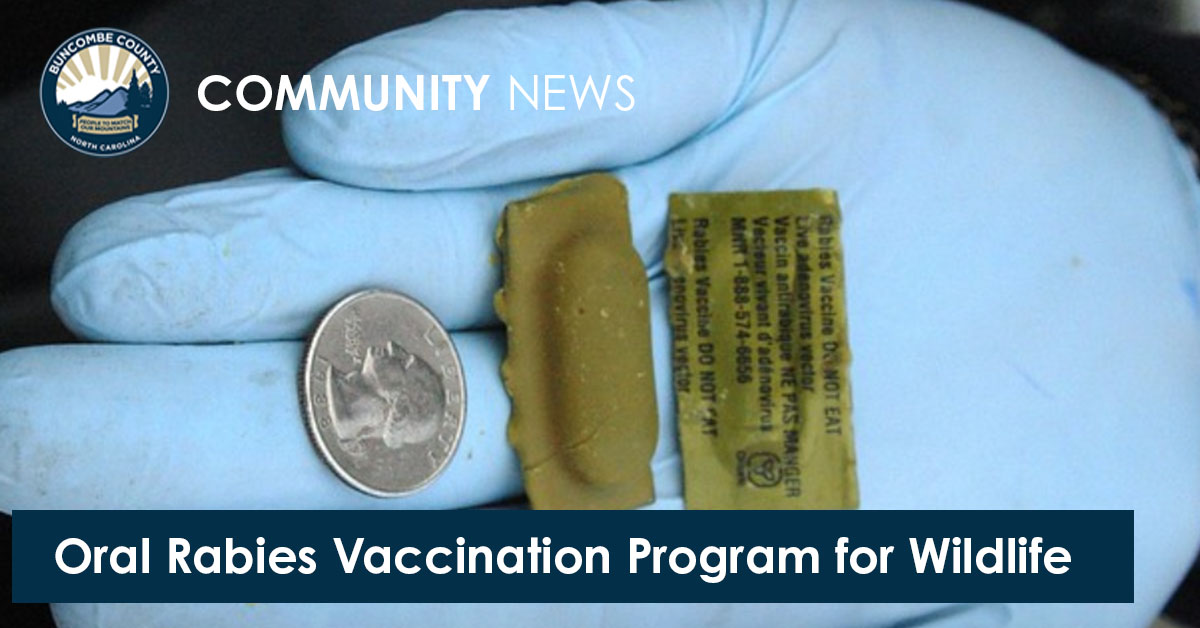
- In urban areas of Asheville, ground teams are distributing approximately 5,400 baits by hand. These baits consist of vaccine sachets encased inside fishmeal polymer baits about the size of a matchbox.
- The entire project is expected to be completed by the middle of October, depending on weather and other factors.
The ORV baits consist of a sachet, or plastic packet, containing the rabies vaccine. To make the baits attractive, the packets are sprinkled with a fishmeal coating or encased inside hard fishmeal–polymer blocks about the size of a matchbox. The baits contain a vaccine that once consumed by a raccoon will vaccinate the animal against the rabies virus.
Tips for Public Encountering Baits or Bait Contact:
- If you find a bait, leave it where you found it unless it is on your lawn, driveway, or other area unlikely to attract raccoons. While wearing a glove, you can move the bait to an area of thicker cover where raccoons are more to likely find it.
- Wash your hands thoroughly with soap and water after any contact with baits. An intact bait will not harm you, but the fishmeal smell may get on your skin. If a bait is broken and the liquid vaccine is visible, use gloves to place the bait in a bag and dispose of it with your regular trash. Once the bait has ruptured, it will no longer be effective. Again, be sure to wash your hands thoroughly with soap and water after any contact with a bait.
- This vaccine has been shown to be safe in over 60 different species of animals, including domestic dogs and cats. Eating a large number of baits may cause a temporarily upset stomach in your pet but does not pose a long-term health risk. Do not attempt to remove a bait from your pet; doing so may cause you to be bitten.
- The vaccine does not contain the live rabies virus; however, it contains a single gene that may cause a local pox-type infection in people who are pregnant or have an immunodeficiency disease. Anyone who comes into contact with the liquid vaccine should wash the affected area thoroughly with soap and water and call the phone number listed on the bait or your local health department for further instructions and referral.
To prevent rabies exposure within your community, please make sure to vaccinate your domestic pets and livestock to protect them from contracting the rabies virus. Officials also advise against feeding or interacting with wildlife. ORV has been distributed in North Carolina since 2005 through a cooperative effort among the U.S. Department of Agriculture’s Wildlife Services and the North Carolina Department of Health. More information is available at: https://www.aphis.usda.gov/aphis/ourfocus/wildlifedamage/programs/nrmp
Contact the Wildlife Services Office at 1-866-4-USDA-WS (1-866-487-3297) for more information or with any questions.